
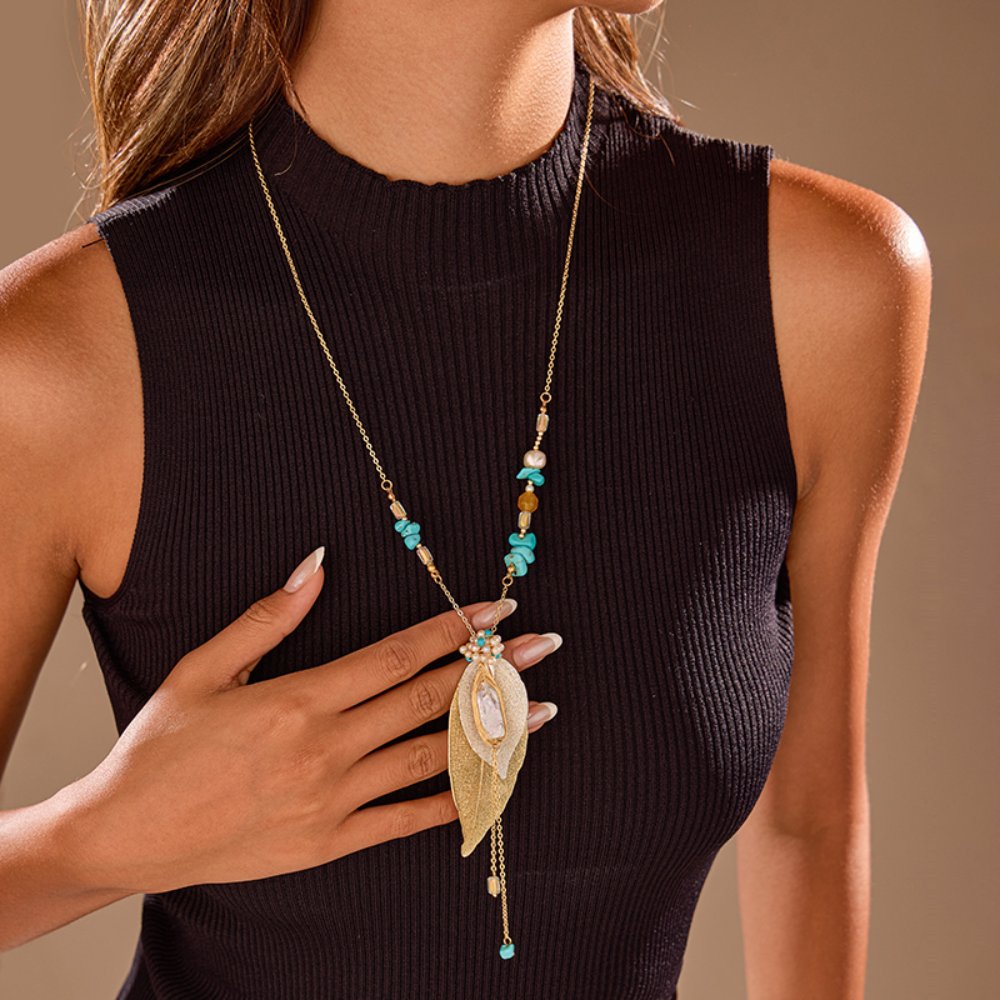
For a leaf pendant RFQ, identify the visible display face, request a separate reverse view and mark the chain-to-pendant connection. Ask the supplier which offered item each view represents. Approve those references explicitly rather than treating a model photograph as confirmation of both faces, the unseen attachment or the pendant’s material composition.
Explain which visible design prompted the enquiry
The Cljewel homepage presents a necklace under the name Natural Vajra Leaf Necklace, European & American Style. Its product photograph shows a large leaf-shaped pendant worn on a long necklace. The buyer can use that image and the observed product link to identify the design of interest. The name remains the supplier’s catalogue wording; the photograph does not independently establish a natural leaf material or a manufacturing method.
Begin the enquiry by asking whether the supplier is quoting that pictured design or an expressly identified alternative. Mark the pendant in the reference image if other visible elements could cause confusion. Because this reference comes from the homepage presentation, request the missing product details directly rather than borrowing dimensions or material descriptions from another jewelry item’s listing.
Define the front by its presentation
A buyer may use front to mean the face shown towards the viewer in the catalogue photograph. A supplier may use front to mean the face chosen during assembly or inspection. Establish one shared reference by marking the intended display face in an image of the offered pendant. Use a descriptive label such as display face A, with an arrow showing which end is nearest the necklace connection.
Ask the supplier to photograph that face without assuming its exact size from the model image. The model’s clothing and wearing position provide a presentation context, not a dimensional scale. If silhouette or surface detailing is important to the selection, identify the feature in the marked reference and ask the supplier to show it clearly on the offered sample. Keep appearance approval separate from any unconfirmed composition claim.
Request the reverse as a distinct view
The reverse can remain unseen in an image taken from the intended display side. Ask for an image labelled reverse B of the same offered item, with enough information to connect it to face A. Do not assume the reverse repeats the front pattern, has the same surface finish or is intended to be displayed. These are questions for the supplier about the identified version, not properties established by the homepage photograph.
If the buyer expects the pendant to be presentable from either side, state that expectation and ask whether the offered construction supports the requested presentation. If only the marked face is being approved for display, record that narrower approval. A useful response shows what is actually offered and leaves any requested variation clearly identified, rather than implying that a different reverse can necessarily be produced.
Make a view-to-question map
The table gives purchasing staff a record of the view that supports each decision. Leave an unavailable view marked outstanding rather than assuming it matches the visible side. If different sample references appear across the photographs, ask the supplier to reconcile them before the buyer treats those images as one complete description of a single pendant.
Reference view | What the buyer marks | Question for the supplier
Display face A | Selected silhouette and visible detailing | Does this view show the quoted item?
Reverse B | Same item turned to its opposite face | What is supplied on this surface?
Connection C | Pendant-to-necklace connection location | Which face and direction does it establish?
Offered sample | Sample reference and quotation option | Are all views of the same offered version?
Approval scope | Named views and specific accepted features | Which questions remain unresolved?
Proposed alternative | Changed feature and replacement reference | Is this a different quoted option?
Check the connection without inferring wear behaviour
Request a close view of how the pendant connects to the necklace, and ask the supplier to identify the orientation shown in the complete-item photograph. The buyer can then compare the connection location with the selected display face. This is a visual identification task. It does not prove that a pendant will always face one direction, remain stationary or behave the same way during every person’s use.
If orientation during display is a purchase requirement, describe the intended display arrangement and ask what the supplier can confirm for the offered version. Avoid instructions to alter or force a sample connection. Any additional evaluation should use an agreed procedure appropriate to the actual item, with its result recorded separately from a simple photograph approval.
• Label each image with the same offered item reference.
• Treat the unseen reverse as an open question until shown.
• Separate an orientation request from a proven wear-performance claim.
Close the approval with a specific evidence set
A complete visual approval can name the accepted face A image, reverse B image and connection C image, together with the sample or quotation option they represent. State any exclusions, such as material identity or unconfirmed dimensions, in the same record. This prevents a short approval message about the pendant’s appearance from being read as acceptance of every description associated with a catalogue category.
If a later sample changes the reverse or the connection, ask which earlier approval references it replaces. Keep the previous images and the supplier’s explanation rather than silently overwriting the record. Send the marked view request through the contact page on cljewel.com. Ask separately for the current commercial offer, leaving availability, minimum order quantity, price and timing unconfirmed until the supplier answers for that item.
Frequently asked questions
Does a model photograph establish both faces of a pendant?
No. It identifies the face visible in that presentation. Request the reverse and the connection view of the same offered item, then state which features each approval covers.
Does the catalogue word natural verify what the leaf-shaped pendant is made from?
No. Treat it as supplier naming until the applicable item-specific material information and any evidence required by the buyer have been provided. Do not infer composition from shape or colour.
Can the buyer approve appearance while measurements remain open?
The approval can expressly cover named visual features only. Keep measurements and their definitions outstanding, and do not represent that limited appearance approval as complete acceptance of the order specification.
Product and contact references
Product reference: https://cljewel.com/product/natural-vajra-leaf-necklace-european-american-style/
Related jewelry reference: https://cljewel.com/product/european-american-style-natural-rose-freshwater-pearl-lariat-necklace/
Contact Cljewel: https://cljewel.com/contact/
Cljewel blog: https://cljewel.com/blog/