
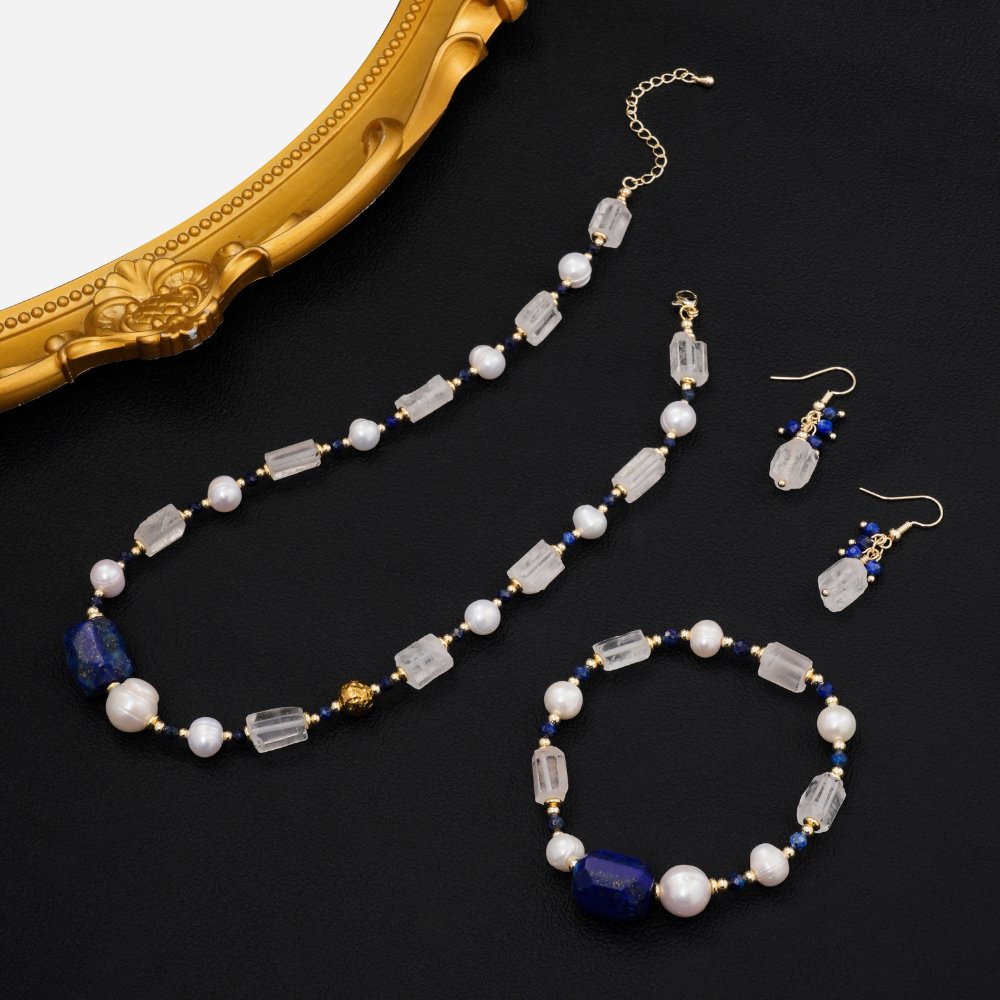
A jewelry set RFQ should list each component, the unit used to count it and the quantity included in one complete selling unit. State explicitly whether earrings are counted as individual pieces or pairs. Ask the supplier to confirm the component list against the exact quoted item, then use the same unit map for sample review, ordering and packing instructions.
Start with the supplier’s identified set reference
The Cljewel product page titled Vintage Style Clear Crystal Lapis Lazuli & Pearl Jewelry Set states that its set includes one necklace, one bracelet and one pair of earrings. Use that description as a catalogue reference when asking what the supplier is currently offering. The product name contains the supplier’s material descriptions; it is not independent evidence of composition, gemstone identity, pearl origin or an agreed specification for an order.
Attach the product link to the RFQ and ask for the supplier’s current item reference. A photograph showing several matching articles can support identification, but the quotation still needs a written list of the supplied components. If the supplier offers a necklace-and-earring option without the bracelet, record that option separately instead of leaving both offers under the same unqualified set description.
Separate a commercial set from a physical piece
A set is a commercial grouping, while a piece is a physical article. In the page’s stated grouping, the necklace, bracelet and two individual earrings are different physical articles, with the earrings described commercially as one pair. This distinction matters when a quotation uses a price per set and another document uses a total piece count. Name the unit beside every quantity rather than relying on a column headed quantity alone.
Avoid using a single total to communicate all of these levels. A buyer can order complete selling units while asking the packing list to show component quantities separately. That does not require the supplier to package each component individually. Packing arrangements are a separate question, and any proposed arrangement should remain a request until the supplier confirms what its quotation includes.
Build a component map before calculating totals
Only multiply quantities after the supplier has confirmed this map. Ask for a component breakdown alongside the total number of selling units if receiving staff need to check completeness. If a document uses a different unit, resolve that difference explicitly. Do not silently replace pairs with pieces or treat an inner pack as one set because the resulting total appears plausible.
Component or level | Unit to state | Supplier confirmation
Necklace | Individual necklace | Number included in the quoted set
Bracelet | Individual bracelet | Included or quoted as a separate option
Earrings | Pair and individual earring count | How the offer defines a complete pair
Complete selling unit | One confirmed set reference | Exact component grouping sold together
Inner packing | Named pack or bag arrangement | Whether it contains sets or separate components
Shipment totals | Sets plus component breakdown | Counts reconciled to the confirmed unit map
Use the sample to identify the grouping
When requesting a sample, specify whether the buyer needs one complete offered set or selected components for appearance review. Ask which quotation option the sample represents. A partial sample can help identify a design, but it cannot by itself establish that the commercial offer includes all the components the buyer expects. Record missing or separately supplied components as open questions rather than treating the sample as automatically complete.
For earrings, request enough information to understand the offered pair. The buyer may need to confirm whether the two earrings match or follow an intentionally different design. Do not infer the unseen side or an unphotographed second item from a single image. Keep the approved component identities beside the sample reference so a later change to one item does not silently alter the rest of the set.
Keep dimensions and material evidence in their own fields
The referenced page also contains dimensional descriptions, including a bracelet measurement whose stated basis needs clarification. Do not use an ambiguous dimension as a confirmed circumference, assume a different meaning or invent a corrected number. Ask the supplier to identify the measured article and mark the measurement points on a drawing or sample. A component count can be confirmed while that dimensional question remains unresolved.
Likewise, agreement on the set’s contents does not verify its materials or any skin-contact performance. If composition or other claims affect the purchase, request the applicable item-specific information and evidence separately. A product category, photograph or material word in a listing should not become a promise of authenticity, allergy suitability, certification or plating performance in the buyer’s own description.
• State pairs and individual pieces as separate named units.
• Attach every component list to one offered set reference.
• Keep unresolved dimensional and material questions visible.
Carry the same units into the purchase order
Before issuing an order, compare the quotation’s unit names with the buyer’s purchasing and receiving records. Keep the agreed set reference and component list together. If spare or replacement components are requested, identify them as additional lines so they do not change the apparent number of complete selling units. Ask the supplier how those additional lines would be identified in its documentation.
Send the component map through the contact page on cljewel.com and ask for the exact offered grouping and any packing clarification. Leave order minimums, price and delivery timing as quotation questions until they are answered for that option. The useful result is a shared counting language: purchasing orders a defined selling unit, and receiving staff know which physical components that unit is expected to contain.
Frequently asked questions
Does one pair of earrings mean one physical earring?
No. Distinguish the commercial pair from the individual articles, and ask the supplier to confirm how it states the pair and component quantities in the quotation and packing documents.
Does approval of the necklace sample approve the whole set?
Only if the approval expressly covers the identified complete set and its components. Otherwise record which sample items were reviewed and which components still need identification or confirmation.
Can a buyer use an unclear bracelet dimension to complete the order sheet?
Keep it unresolved. Ask for the measured article, measurement points and the supplier’s confirmed definition. Do not convert an ambiguous listing into a verified circumference or invent a replacement value.
Product and contact references
Product reference: https://cljewel.com/product/vintage-style-clear-crystal-lapis-lazuli-pearl-jewelry-set/
Related jewelry reference: https://cljewel.com/product/18k-gold-plated-pink-quartz-heart-tassel-jewelry-set-necklace-earrings/
Contact Cljewel: https://cljewel.com/contact/
Cljewel blog: https://cljewel.com/blog/